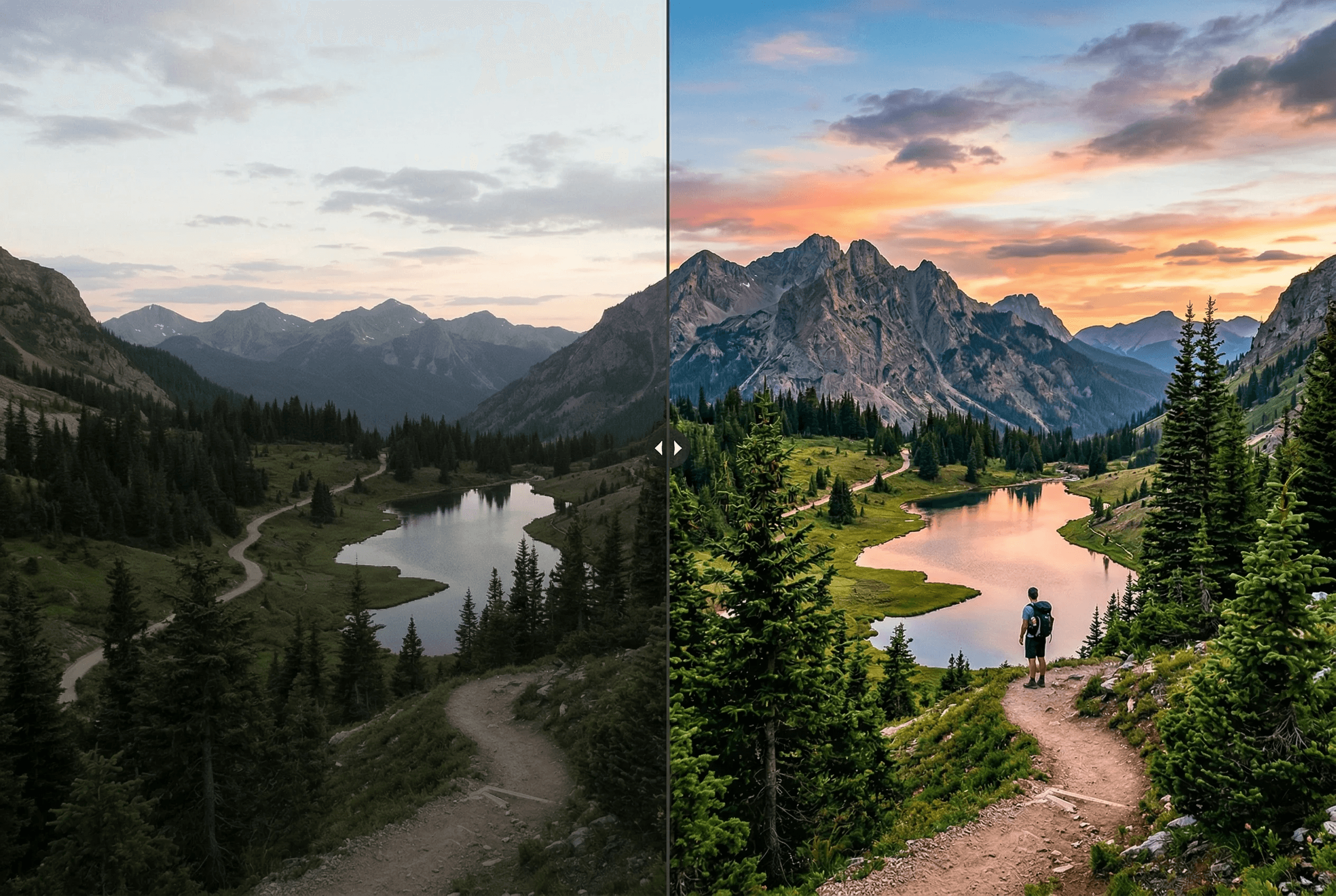
Enhance Any Photo Automatically
Advanced AI that understands your image and makes it look its best.
Auto-correct exposure, white balance, and contrast
Improve sharpness and reduce noise intelligently
Boost color vibrancy without oversaturation
Custom prompt: describe exactly how you want it enhanced
Works with portraits, landscapes, products, and any photo
Batch enhancement for multiple images
Fixes underexposed indoor and night-time photos
Cleans up JPEG compression artifacts and grain
Preserves the original composition — no auto-cropping
How It Works
Get professional results in just a few simple steps.
1
Upload your photo
2
Optionally add enhancement directions
3
AI analyzes and enhances your image
4
Download the enhanced result
What People Enhance with ImageAI
Real situations where one-click enhancement saves a photo — or a whole catalog.
Ecommerce product photos shot on phone
Fix uneven lighting, weak whites and dull color so a phone snapshot looks like a studio shot before it goes on Shopify or Amazon.
Underexposed indoor & restaurant photos
Recover detail in dark areas, fix mixed indoor lighting (tungsten + window), and brighten without crushing highlights.
Real estate listing photos
Brighten interiors, balance window light against room light, sharpen architectural detail — all in one pass.
Portraits with bad white balance
Fix orange tungsten cast or cool fluorescent cast on skin tones without manually adjusting curves.
Travel & landscape photos
Restore sky color, lift shadows in foreground subjects, sharpen distant detail.
Social media content pipeline
Run every Instagram, TikTok or Pinterest post through enhance for consistent brand-quality output.
Image Enhancer Output Specs
What the tool actually changes — and what it leaves alone.
| What gets enhanced | Exposure, white balance, contrast, sharpness, noise, color vibrancy |
|---|---|
| What's preserved | Composition, cropping, subject identity, original resolution |
| Custom prompt | Optional natural-language direction (e.g. 'make it warmer, more contrast') |
| Input formats | JPEG, PNG, WebP, HEIC |
| Output format | PNG by default, or matches your input |
| Average processing time | 3–8 seconds per image |
| Batch support | Yes — multi-image upload supported |
| Cost | 1 credit per image — see pricing for details |
How it works
Auto Enhance vs Manual Editing
Manual photo editing means dragging exposure sliders, eyeballing white balance, sharpening selectively, and denoising in tight crops. For one hero image, that's fine. For a 200-SKU catalog or a daily content pipeline, it's a part-time job.
AI image enhancement collapses that workflow into a single forward pass. The model analyzes the image — what kind of subject it contains, what the lighting looks like, where the noise is — and decides which corrections to apply and by how much. Because it sees the whole image as one signal, it can do things a slider-based workflow can't: lift shadows on a subject without blowing out a window behind them, sharpen detail in a face without amplifying noise in the background, fix a color cast on skin while leaving the wall color natural.
ImageAI's enhancer also accepts a natural-language prompt as steering. Add 'make it warmer and more contrasty' and the model biases toward that look. Add 'product photo, neutral white background' and it leans the other way. This gives you the speed of auto-enhance with the directional control of a manual edit — without ever opening an image editor.
When Enhancement Doesn't Help
A few cases where the enhancer is the wrong tool — and what to use instead.
Image is too small for the final use
Enhancement won't add resolution. If the source is 600px and you need 2000px, run the Image Upscaler first, then enhance.
Heavy motion blur or out-of-focus subject
Enhancement sharpens detail that exists. It can't recover detail that was never captured. Re-shoot if possible.
You need creative re-styling, not correction
If you want a 'film look' or 'oil painting' effect, use Style Transfer. Enhance only does corrections, not stylization.
Product photo with the wrong background
Enhance fixes lighting and color. It doesn't change the background — run Remove Background first if your subject is in front of a busy scene.
Frequently Asked Questions
Can I control how the image is enhanced?
Yes. You can add a natural-language prompt describing what you want — like 'make it warmer', 'increase contrast and sharpness', or 'neutral product photo, clean whites'. The model uses the prompt as steering on top of the automatic corrections.
Does it work on phone photos?
Absolutely — phone photos are one of the main use cases. The enhancer is designed to fix the common smartphone issues: weak exposure, color cast from indoor lighting, low-light noise, and soft sharpness. Output looks much closer to a DSLR shot.
Will it change my image composition?
No. Enhancement adjusts quality attributes (exposure, color, sharpness, noise). It never crops, rotates, removes subjects, or changes what's in the frame. Composition is preserved exactly.
Does it work on ecommerce product photos?
Yes — product photography is one of the most common workflows. Phone-shot product photos often have uneven lighting, soft whites and dull color. One pass through enhance brings them up to publishable quality. Pair with Remove Background and Upscaler for the full workflow.
What's the difference between Image Enhancer and Image Upscaler?
Enhancer fixes quality (lighting, color, sharpness, noise) at the existing resolution. Upscaler increases resolution by 2x or 4x while generating new detail. They solve different problems and pair well: enhance first to clean up the source, then upscale to get the final size you need.
Will it remove noise from low-light photos?
Yes. The enhancer specifically detects and reduces ISO noise, JPEG compression artifacts, and color noise from sensor heating — without smearing fine detail the way generic denoisers do.
Can I process many photos at once?
Yes — use multi-image upload to run the same enhancement settings on a whole batch. Useful for ecommerce catalogs, real estate shoots, or any case where you need consistent treatment across many images.
Is my image data kept private?
Uploads are processed for the duration of your enhancement job and then automatically deleted from temporary storage. We don't sell your images or use them to train third-party models. See the contact page for enterprise data agreements.
Related guides & tools
Explore More Tools
Remove Image Background Instantly
Remove backgrounds from any image in seconds with AI precision.
AI Image Expander — Extend Canvas
Extend image canvas in any direction with seamless AI fill.
AI Object Eraser — Remove Unwanted Objects
Remove unwanted objects from photos with AI-powered fill.
AI Inpainting — Edit Specific Areas
Mask and regenerate specific areas of an image with AI.